


History
Opening on January 5, 1929, it was the pride of Phoenix, a town of 48,000. Designed by architects Lescher & Mahoney, the theatre was built for $750,000 by Jo E. Rickards and Harry Nace. The Orpheum was designed in the atmospheric style making the audience feel like they were sitting in a garden surrounded by Spanish style buildings and mountains ranges. Puffy white clouds moving across a deep blue domed sky completed the illusion.
The theatre had 1,800 seats and an early form of air conditioning making it one of the coolest places to be in Phoenix. Its 101 feet of stage width and 28 feet of depth made the Orpheum the only theatre between Los Angeles and Denver able to handle the traveling vaudeville shows that changed weekly.

Arizona Republican, January 5, 1929
The first year brought a variety of shows in "picture, talkies, and stage". It also brought new owners when Rickards and Nace sold part of their Arizona theatre empire to Publix Theaters Inc, a Paramount Pictures company, in November of 1929.

Arizona Republican, November 3, 1929
Over the next thirty-five years, the Orpheum mostly operated as a movie palace, but also hosted live performances by local dance companies like the Gene Bumph dancers as well as stars of the stage and screen like Mae West, Bill “Bojangles” Robinson, Fannie Brice, Gypsy Rose Lee (as Rose Louise Hovick), Ethel Barrymore, and Vincent Price.

Gypsy Rose Lee
(as Rose Louise Hovick)
Arizona Republican, March 10, 1929

Fanny Brice
Arizona Republican, January 20 1935

Mae West
November 23, 1933 - Orpheum Theatre Foundation
In July of 1946 the Orpheum Theatre was advertised as a "Nace Paramount Theater" for the first time, but the name did not officially change to Paramount until 1951. Harry Nace continued to manage the theatre, but took on a smaller role due in part to his quest to bring baseball to Arizona. Celebrities like Charleston Heston, Dick Clark, Mae West, and architect Frank Lloyd Wright made appearances at the Paramount as did Phoenix's very own Wallace and Ladmo.

Arizona Republic, March 3, 1951

Arizona Republic, February 14, 1951
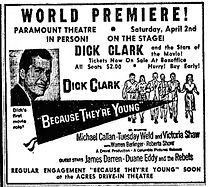
Arizona Republic, March 29, 1960
The theatre became Palace West in April of 1968 when it was purchased by James Nederlander of the Nederlander Theatrical Corporation. As a newly added stop on the Broadway circuit, the theatre played host to many Broadway and Hollywood legends including Mary Martin, Johnny Mathis, Robert Preston, Art Carney, Billy Dee Williams, Lauren Bacall, and Henry Fonda.

Arizona Republic, March 21, 1971

Arizona Republic, June 16, 1967

Arizona Republic, February 16, 1969

Arizona Republic, February 29, 1972
In the 1970's the Corona family leased the theatre from James Nederlander. The Corona family breathed life back into the practically shuttered theatre. Over the next seventeen years it was all hands on deck for the family. From the box office to the projection room almost every member of the Corona family had a hand in operating the theatre.
Still known as Palace West, the theatre screened Spanish language films as well as dubbed or subtitled versions of box office hits like "The Exorcist", "The Godfather", and "The Empire Strikes Back". There were also live events including boxing matches and concerts.
Hispanic artists like Julio Iglesias, Cantinflas, Vikki Carr, and Jose Jose performed at Palace West in the 1970's while acts like INXS, Adam Ant, R.E.M., Sheena Easton, Patti LaBelle, and Berlin were the headliners in the early to mid 1980's. The Corona family also opened a record store, "El Palacio de los Discos", in the retail space of the theatre.

Arizona Republic, October 28, 1975

Arizona Republic, March 14, 1976

Arizona Republic, May 2, 1984

Arizona Republic, October 10, 1980

Arizona Republic, August 26, 1984

Arizona Republic, July 26, 1985
By the mid-1980s the tired, worn, and outdated theatre was well on its way to being razed when voters rejected a proposition that included funding to restore Palace West in the spring of 1984. Thankfully, Mayor Terry Goddard had another idea.
Mayor Goddard proposed incorporating the theatre into the plans for the new city hall. The new high-rise would be built behind the theatre and would provide utilities and services to both structures. In addition, the street in front of the theatre would be closed, landscaped, and made into a plaza.
Because of Mayor Goddard's vision, the theatre was spared from the wrecking ball when in the fall of 1984 the City of Phoenix purchased the building from James Nederlander.

Arizona Republic, October 16, 1984

Arizona Republic, October 17, 1984
The Junior League of Phoenix played a significant role in the restoration. In addition to a gift of $50,000, they also worked with the State Historic Preservation Office to have the theatre placed on the National Register of Historic Places in September of 1985. In May of 1987, the Phoenix City Council unanimously voted to help fund part of the restoration project and the Junior League of Phoenix committed to raising an additional $100,000 through private donations.

Arizona Republic, February 24, 1985

Arizona Republic, May 13, 1987
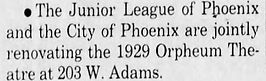
Arizona Republic, January 3, 1988
The name of the theatre was restored to its original name of Orpheum in February of 1988. Later that same year the citizens of Phoenix passed a bond initiative including $7 million dollars going towards restoration of the theatre. A year later the Orpheum Theatre Foundation was founded to help raise the additional funds needed for the restoration.

Arizona Republic, February 11, 1988
With most of the funding in place, renovations began in April of 1995. Much of office space on the second floor of the building was demolished. The shops on the ground floor were transformed into an expanded lobby and box office. The stage was expanded to a depth of 47 feet and the fly was extended upward to 66 feet. An interior loading dock was constructed underneath city hall to serve the theatre. Seating capacity was reduced to 1,400 with wider and accessible seats added in the main auditorium.
.jpg)
Arizona Republic, April 5, 1995
When all was said and done, even the clouds, stars, sunrises, and sunsets returned, but not without cost. The original building cost $750,000, returning it to its 1929 glory cost $14,500,000. The music also returned thanks to the Valley of the Sun Chapter of the American Theatre Organ Society who purchased a Mighty Wurlitzer Theatre Organ for the theatre.

Arizona Republic, January 5, 1997

Arizona Republic, January 28, 1997
The grand re-opening took place on January 28, 1997 with Carol Channing in "Hello Dolly". Ms Channing may have been the headliner, but the newly renovated Orpheum Theatre was the star of the show.

Arizona Republic, January 29, 1997
Today the Orpheum Theatre hosts live performances, classic movies, and silent films complete with live accompaniment on the Mighty Wurlitzer Theatre Organ.

Orpheum Theatre Foundation